
safety handbook for hydraulic oil
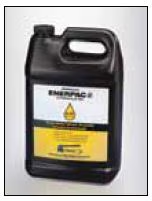
All oils are not alike. The correct oil will protect moving parts and will not damage seals. Using the wrong oil will damage your equipment and lead to malfunctions. Use Enerpac premium hydraulic oil. The most important oil characteristic is viscosity. Heat is also an important factor.
See the chart below for details.

Characteristic
Viscosity
Operating
Temperature
Enerpac Specifications
42-45 SUS @ 210⁰F
[5.3-5.4 cSt @100⁰C]
150-165 SUS @ 100⁰F
[30-32 cSt @ 40⁰C]
150⁰F [65⁰C] maximum
Effects
Viscosity describes the ability of an
oil to flow. If the oil is too thin, there is
not enough lubrication. If the oil is too
thick, it will not flow fast enough to
perform as required.
High temperatures also cause seal
damage. In general, if the system is
too hot to touch, it is too hot to use.
REMEMBER: Always dispose of used oil properly. Observe local ordinances. Do not mix used hydraulic oil with other fluids.
Oil Specifications Chart:
ISO Grade
Viscosity Index
Viscosity at 210 °F
Viscosity at 100 °F
Viscosity at 0 °F
API Gravity
Flash, C.O.C. °F
Pour Point, °F
Paraffinic Base Color
LX Oil
15
101 min
3.2/3.7 S.U.S.
13.5/16.5 S.U.S
<2100 S.U.S.
31.0/35.0
370
-30
Yellow
HF Oil
32
100 min
42/45 S.U.S.
150/165 S.U.S.
<12000 S.U.S.
31.0/33.0
375
-25
Blue
NOTE: SAE grades do not apply to hydraulic oil.
Click the following link to view the entire Safety Seminar Handbook
